Lost objects and horary astrology: how a chart finds what you lost

You have checked every pocket, emptied the bag, moved the sofa. The thing you lost still has not appeared, and it matters to you. This is the moment traditional horary astrology was made for: a serious question, asked after a sincere search, answered from a chart cast for the moment the astrologer understands the question.

Lost-object questions are the most concrete branch of horary. The chart either points to the right place or it does not, and the searcher usually finds out within hours. What follows is a real, verified case, resolved by Pilar Manso, an astrologer in Madrid who trained in the horary course at María Blaquier's academy. It shows, step by step, how a chart can describe where a missing object waits.

Horary chart for the lost jewels case: Ascendant 4°24′ Capricorn, Saturn retrograde in Aquarius, Moon in Pisces, Sun in Gemini. June 1st 2021, 23:18, Madrid.
The chart for “Where are the jewels?”. Highlighted significators: Saturn (querent and object), the Moon, and the Sun (the gold). Redrawn from Pilar Manso's real case.

The question: where are the jewels?

On June 1st at 23:18 in Madrid, Pilar read and understood her friend's question: "Where are the jewels?" The jewels were two gold crosses set with small stones that had belonged to the friend's grandmother. She had hidden them so well that she could no longer find them, and they had been missing for a long time. She lives alone with her cat.

This is the chart Pilar cast for that moment and place, the same chart she judged line by line in the written report she sent her friend.

Before judging anything, Pilar checked that the chart was radical, fit to answer. The planetary hour belonged to Mars, and Mars has its exaltation in Capricorn, the sign rising on the Ascendant. That agreement made the chart valid and the question ready to be judged.

The significators: one planet, two roles

The Ascendant stood at 4 degrees of Capricorn, so Saturn represented the friend. Saturn was in Aquarius, retrograde. The lost object was ruled by Saturn as well. Here Pilar credits Anthony Louis's lost-objects course: Louis teaches that when the ruler of the 1st house and the ruler of the 2nd house are the same planet, a strong bond ties the object to its owner, and that is a good omen. Saturn in Aquarius also fit the object: something old, a gift from her grandmother.

A retrograde significator for a lost object moves back toward its owner, and Saturn was doing exactly that. It sat technically in the 1st house but less than five degrees from the 2nd house cusp, so it acted on the 2nd while it backed toward the person. A planet between two house cusps gives a classic location clue: the object lies between two spaces or zones, behind a door, between rooms, or inside a box that was moved from its usual place. Aquarius added high spots, trunks, and bright places near a window or terrace.

The Moon, co-significator of the querent and of everything that wanders, was in Pisces in the 2nd house. Both significators of the person occupied the house of movable goods, which told Pilar how much the crosses were worth to her friend, in money and in feeling. Pisces pointed to water: bathroom, kitchen, liquids, and also medical items such as a first aid kit, X-rays, or lab results.

For the crosses themselves Pilar took the Sun, the natural significator of gold and jewelry. The Sun was in Gemini in the 6th house. Gemini speaks of boxes, drawers, small containers, something compartmented, and it rules papers, books, and documents. The 6th house rules pets, so the report advised looking in the cat's zone, among her things, and even asking whether the animal could have moved the box while playing. A cadent house meant the object was out of sight and hard to reach. The Sun also sat between two cusps, so the "between two things" theme appeared twice.

Would the crosses come back? The Moon applied to the Sun by square, a contact that kept hope alive but promised the search would cost effort. The Sun also applied to Saturn by trine, a clearly favorable testimony. The Moon's last aspect, a conjunction with Jupiter, ruler of the friend's 4th house, said the jewels were at home: she had stored them with great care and moved them from their usual spot. Five degrees of separation hinted they had been moved five months or five years earlier.

Pilar also listed the testimonies against, because an honest report weighs both sides: the Moon separated from the Ascendant, both lights stood below the horizon, and a weakened Mars occupied the angular 7th house. That Mars could mean someone else had a hand in the loss, even a thief. Pilar set the idea aside. Her friend lived alone, and the chart held too many signs of return.

The report and the verified ending

Pilar sent the report in the morning. It told her friend to search where she kept things of value, money, or bank papers; where she kept medical documents, medicines, or the cat's belongings; near water or liquids; inside a box, between two things, perhaps at mid-height, since some testimonies pointed high and others low. That afternoon her friend wrote back:

Pilar, I just found them. You are not going to believe it. They were under Leo's cushion. Leo is the cat. If you look, there is a yellow folder in the corner next to the drawer. In that yellow folder, and in all the ones below it, I keep my payslips and my medical reports, and there are books on top. The little box with the jewels was wrapped in a duvet cover I no longer use, inside the drawer. And about the water, how funny. I also keep an umbrella there.

Every testimony checked out. The box lay under the cat's cushion, in the exact spot where the cat sleeps: the 6th house, pets. Payslips and medical records sat in folders right beside it, with books on top: Gemini papers and documents, plus the Pisces Moon's medical theme. The small chest of drawers stood between two other pieces of furniture: between two spaces, the clue the chart gave twice. The crosses were inside a box, wrapped in fabric, inside a drawer: something compartmented. And the umbrella closed the water testimony with a wink from the cosmos, as Pilar put it.

Pilar credits the accuracy of this reading to María's detailed feedback in the academy's lost-objects marathon and to Anthony Louis's course, above all his shared-ruler rule. Her own summary is simple: enormous satisfaction, and joy at being able to share it.

What a horary astrologer checks in a lost-object question

The Madrid case worked because it followed a method. Anthony Louis, who has practiced horary since the 1980s and teaches the lost-objects course at María's academy, lays out the checklist in his first lesson. This is what a traditional astrologer examines, in order:

  • A serious question. The chart answers a genuine need. The person searches first, exhausts every ordinary means, and only then asks the sky. A chart cast on a whim rarely speaks.
  • A radical chart. The astrologer first confirms the chart is fit to be judged, for example through agreement between the planetary hour and the rising sign.
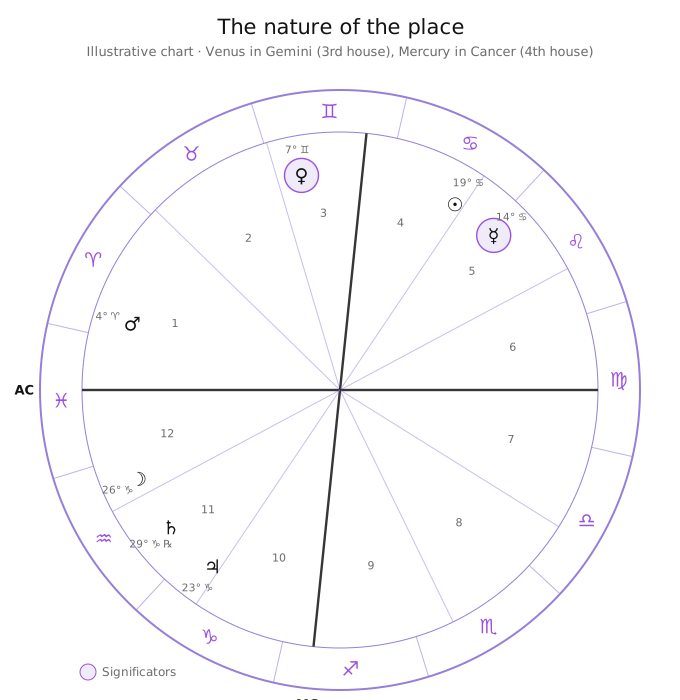
  • The right significators. The ruler of the 2nd house stands for movable possessions and the 4th house for hidden treasure. Each object also has a natural ruler: the Sun for gold and jewelry, Mercury for keys, documents, and cards, Venus for rings and ornaments, Mars for knives and iron. The Moon signifies things that wander and change place, which is why it also represents runaway pets. The Part of Fortune and its ruler can stand for a missing possession.
  • Signs of return. Applying aspects between the significators of person and object show the two coming together. A retrograde significator shows the object on its way back. Squares say the search will cost effort. Testimonies against get weighed too.
  • Where to look. Angular houses place the object near its owner, in plain sight, in places used daily. Succedent houses put it farther away or somewhere less habitual. Cadent houses hide it well. The element of the significator's sign gives height: fire and air rise, so look high, on shelves or upper floors; earth and water sink, so look low, near the floor or below ground, and water adds bathrooms, kitchens, and laundry areas.
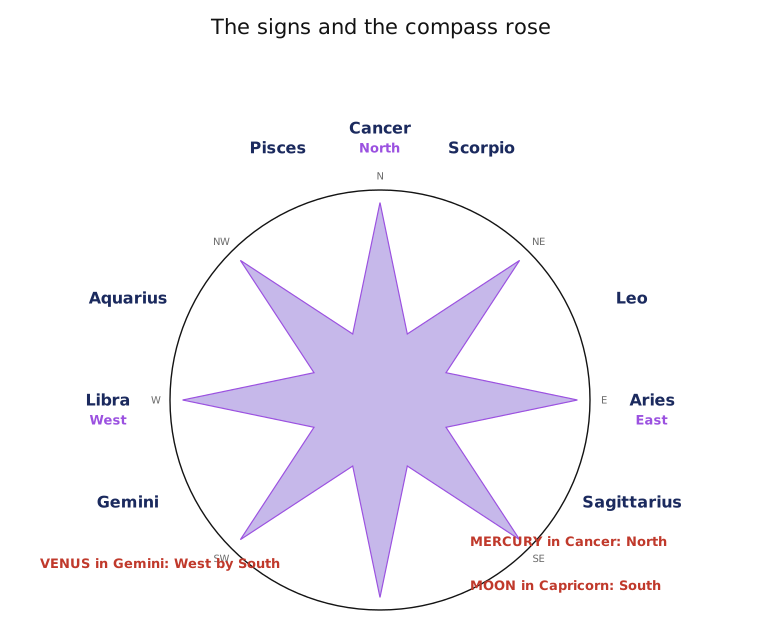
  • A direction. Every sign carries a compass direction: water signs point north, air west, fire east, earth south. The chart itself is oriented, with east on the Ascendant and south on the Midheaven. When most significators share an element, the astrologer can name the side of the home to search first.
  • How it was lost. The Moon's last aspect describes what happened: hidden, stored, moved, or taken. Degrees between planets can even suggest when.
  • The querent's knowledge. Chart symbols are general, so the astrologer needs the client to describe the home, who lives there, and how the loss happened. Louis calls this a two-person search. John Frawley's experience adds a shortcut: check the place the client swears it cannot be, and check wherever children or a partner spend their time.
Louis is the first to admit that no astrologer finds the object every time. When it works, he says, the satisfaction is enormous. That honesty is part of the craft: the astrologer weighs the testimonies for and against, and tells the client the truth about both.

One more point matters. Every chart at horary-chart.com is read by hand. An automatic calculator can draw the wheel, but the wheel alone answers nothing: the judgment, the weighing of testimonies, and the written report are handcrafted work.

Have you lost something that matters to you?

If you have already searched and the object still has not appeared, you can ask your question here. María Blaquier holds the Horary Diploma from the School of Traditional Astrology in London, is an OPA member, and reads each chart personally. A reading costs USD 85, your written answer arrives within 48 hours, and every reading carries a 365-day satisfaction guarantee. The service holds a 4.9 out of 5 rating across 31 verified reviews.