How to read a horary chart

How to read a horary chart with María Blaquier's method
Horary astrology answers pointed questions: is this job right for me? Is my friend loyal to me? To answer, the astrologer casts a horary chart for the moment and place where the question is received and understood, and reads it with a method that comes from centuries of tradition. This is how María Blaquier teaches it, and this is how you will see it here, step by step.
Before we start, let us be honest: reading a horary chart is a craft that takes years of study and practice with real charts. This article shows you what the astrologer does when reading a horary chart; it does not qualify you to do it on your own. With that said, let us take it one step at a time.
1. The question and the exact moment
Everything begins with a concrete question, born of genuine concern. There is debate about which time and place to use: some astrologers take the place and time where the question was asked. María works with the technique of William Lilly, who settles it plainly in his Christian Astrology:
The minute of the hour when I open the letter and perceive the intention of the querent: that is the moment when I should erect the figure, and from it draw my astrological judgment.
Understanding the question well is the first task. "Is my friend loyal to me?" points to one house; "is the person I am interested in seeing my friend?" points to another. The significators come out of the question, and everything else comes out of the significators.
2. Checking radicality
Before reading, María checks whether the chart is radical: whether the question is well rooted. As she explains it: for a chart to be radical, the ruler of the planetary hour and the Ascendant have to agree.
The hour ruler comes from the planetary hours, an ancient clock that divides the day among the seven visible planets in the Chaldean order, from slowest to fastest: Saturn, Jupiter, Mars, the Sun, Venus, Mercury and the Moon. The first hour belongs to the planet ruling the day (Monday opens with the Moon, Wednesday with Mercury) and the sequence runs from there. Each hour has its own weather: Venus for love and celebrations, Jupiter for asking favors or employment, Mars for disputes, Saturn for land and property, which demand effort.
Agreement is checked two ways. The first is triplicity: the planet of the hour should rule the triplicity of the Ascendant's element (fire, earth, air or water) in the Ptolemaic table Lilly used, according to whether the chart is diurnal or nocturnal. The second is temperament: planet and rising sign should share something among hot, cold, dry and moist.
Two cases from her classes. A querent asked whether her friend was loyal: Mercury's day, Saturn's hour, Aries rising, a diurnal chart. Saturn rules the air triplicity in diurnal charts, not fire: first path ruled out. Saturn is also cold and dry in the extreme while Aries is a very hot sign: no shared temperament either. A non-radical chart.
Another querent asked about a surgery: the Moon's hour, Aries rising, diurnal. The Moon belongs to the nocturnal sect, and the fire signs are ruled by diurnal planets (the Sun, Jupiter and Saturn); the Ascendant is hot and the Moon is moist. Another non-radical chart.
Are these charts discarded? No. "It does not matter, we will read it anyway," María says in class. Radicality gives confidence; when it is missing, the reading asks for more care. And the house where the hour ruler falls is informative in itself: in the friend's chart, Saturn sat in the 10th house, in its own domicile and its own term: that suggested work, prestige or social standing at the root of the question.
3. Finding the significators
The next step is handing out the roles: who is who inside the horary chart.
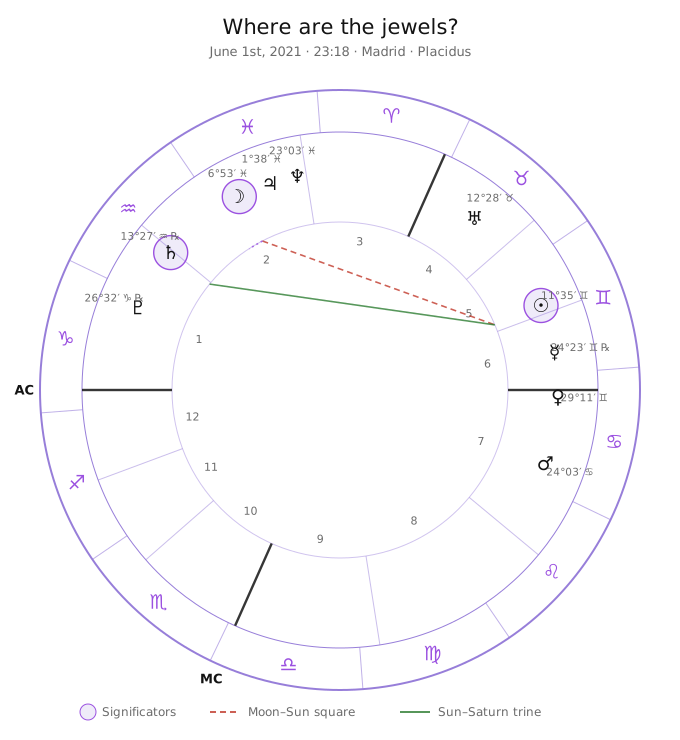
- The querent is represented by the Ascendant, the planet ruling it, and any planets in the 1st house, which act as secondary significators or co-rulers. With the Ascendant at 11 degrees of Gemini, for example, Mercury represents the querent, and a Venus in the 1st house is her co-ruler.
- The quesited (the thing asked about) is represented by the house of the matter: a partner by the 7th, a pet by the 6th, a child by the 5th, a sibling by the 3rd, a friend by the 11th. The ruler of that house is the other main significator and, following Lilly, planets inside the house co-rule the matter.
- The Moon is co-significator of everything: the fastest body, it shows how events will unfold. If one planet represents both querent and quesited, the Moon can take one of the two roles.
Choosing the right house is an art in itself. In practice the doubt came up: a friend who is "almost a sister": 11th house or 3rd? María's answer: if the querent says "friend," use the 11th; if she lives the bond as a sister's, the 3rd can serve. That is why it pays to ask how the relationship is lived before deciding. When the question concerns third parties, derived houses come in: the mother-in-law, for instance, falls in the 4th, because it is the tenth house counted from the 7th. In a chart about a surgery, the operation is the 8th house and the surgeon the 7th: there Venus appeared in Libra, in her own domicile, and the verdict was an excellent doctor.
4. Dignities: how much strength each planet has
The significator says who is who; its condition says how they are doing. María reviews essential dignity (domicile and exaltation give strength; detriment and fall remove it; a planet with no dignity is peregrine) and accidental dignity (the house it falls in, whether it is retrograde, whether it is combust the Sun, which degree it occupies). If the Ascendant is in Aries and Mars, its ruler, sits in Libra, the querent has little essential strength, because Mars is in its sign of detriment.
The examples from her classes make it concrete:
- A querent asked about her health with Taurus rising and Venus in Taurus, in her own domicile: enormous essential dignity, vitality to spare, nothing to worry about.
- Another asked about his finances for the year: the 2nd house in Scorpio made Mars the significator, exalted in Capricorn. No reason to fear for the wallet.
- A country property in Madrid came out represented by Jupiter, dignity-less and retrograde in Scorpio: the estate was in poor condition, with likely problems of stagnant water or pipes, exactly what Scorpio symbolizes.
- A brand-new job showed up as Saturn in Capricorn at 0 degrees and combust: a good, important position, but a very stressful one, with circumstances beyond the person's control.
Even the degree counts: planets in the last degrees of a sign almost always fall in the terms of Mars or Saturn, the two malefics, and they warn that something is about to change.
5. The applying aspects: the answer
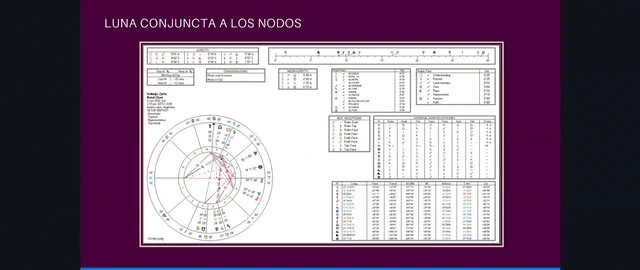
With the roles handed out and the strengths measured, the answer lies in the contact between significators. If the querent's planet and the quesited's planet are applying to an aspect, the matter comes to pass. No aspect, no event: a mother asked whether her son would travel; Venus, the son, made no contact with Jupiter, the trip, and the son did not travel.
The nuance comes from reception: what each planet likes about the place where the other one stands. In the friend's chart there was no aspect between Mars (the querent) and Saturn (the friend), but there was an uneven reception: Saturn stood in Capricorn, the sign where Mars is exalted, and Mars in Aries, the sign of Saturn's fall. María's reading: the friend appreciates the querent and wants to come closer; the querent has raised a wall and does not receive her well.
And there is the Moon, which connects what the planets do not. In that same chart she was separating from Mars and carrying her light to Jupiter: a translation of light that mirrored an introduction made by the friend through a third person. To put the contacts in order you have to move the chart forward in the software and watch the speeds, because the planets do not advance at the same pace. What looked at first glance like "Venus first, then the Sun" turned out to be "Saturn first": the Moon was joining the friend to the querent. "Look how the whole answer changes," María celebrated in class.
More from María Blaquier: courses at her academy · Draconic Chart · Instagram (33k followers) · YouTube (32K subscribers) · this service in Spanish